A L I C I A   K I N G
He being dead yet speaketh
2008
Digital Video
Duration 1:07 (looped)

Performance in which I re-anoint my body with liquid fibroblast and epithelial cells cultured from tissue taken from my body, through biopsy, by a surgeon.

The 3cm x 1cm tissue biopsy was removed from my body, then taken immediatly to the UTAS Medical School and harvested into a cellular solution. Some of those cells were then clinically sterilised, taken from the lab and used as a liquid solution in the re-annointing of my body.

The title HE BEING DEAD YET SPEAKETH is an inscription found on the stone walls of the Multicultural Christian church, which I walk past most days. The inscription frames a board featuring regular messages from God, usually in the form of a cryptic saying or proverb. I find parallels in this Christian notion of continued life/presence physically manifesting after death, in biotechnological continuations of the body. In a way, creating works with he_la cells to tell Henrietta Lacks’ story (as with previous works of my own and other artists) draws direct parallels with the idea of the message board as a form of post-mortem presence.
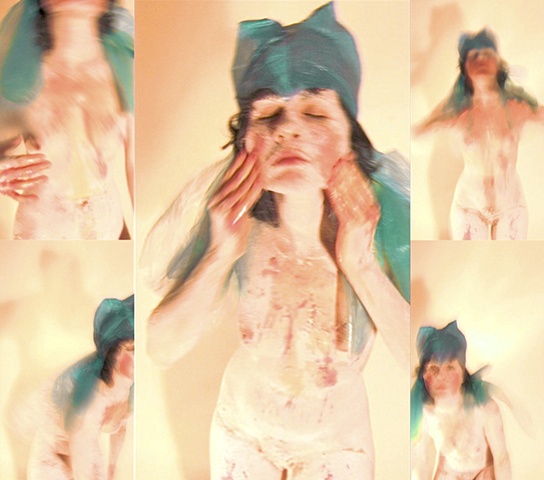
As inferred by the title, HE BEING DEAD YET SPEAKETH conjures notions of life continuing beyond the grave through alternative bodies or vessels, specifically transformation of embodiment and psyche within ritual. The work arose in part as a continued exploration of my relationship with my own body and self perception, as first informed by my facial surgery (which moved my top jaw and facial palate forward) which radically altered my perception of and relationship with my own body. This has fuelled an ongoing exploration of the conceptual relationship between the ruptured body and identity. Removal of my tissue for the purpose of tissue culturing was of great significance to me, as I wanted to explore whether it would further alter my perception of self. On 18th March 2008 a local surgeon removed an elliptically shaped piece of tissue from my thigh (approximately 3cm x 1cm). The tissue was then taken straight to the University of Tasmania’s (UTAS) Medical School, where I spent the evening harvesting it. Once harvested into a liquid solution (minced to a pulp with scissors and separated via centrifugation) the tissue was placed in a vessel of nutrient solution, and into the incubator to begin growing. I had initially intended my cells to be cultured over a three dimensional form, which would later be incorporated into a larger object based work – as I had done with previous works. However, the experience of harvesting my own tissue in the lab changed my approach; I no longer sought to create an object from my tissue. The experience of undergoing the biopsy on my thigh did affect my sense of embodiment, in that it re-connected me with my body in a very visceral and immediate way, however the process of culturing my cells was less of the subjective experience I had expected. I felt disconnected from the tissue; I was compelled instead to engage the cells with my body in a more direct way. The physical barrier of the tissue culture flask and further shield of the sterile hood within the clinical laboratory space created a psychological barrier that prevented me from a satisfying engagement with the tissue sample. To resolve the anxiety around this experience I produced the performance piece HE BEING DEAD YET SPEAKETH. In the performance, recorded on video, I re-anoint my body with my liquid tissue cells , using playful yet trance-like movements that draw upon ritual associations towards bodily material seen in primitive culture and organised religion. To increase the ceremonial aspects I wear an animal headdress inspired by the “supreme priest’s” (aka the Pope) mitre. This headdress draws upon the symbolic power of the Catholic Church. In my manifestation it is made from disposable blue plastic fabric (rather than expensive fabrics), a reference to the utilitarian surgical gown and the power invested in its wearers.

My body is coated in a layer of soft white fur (flock), mimicking the down of a newborn lab mouse. Covered in metaphorical fur I am part human, part animal. The trance-like atmosphere of the piece draws a primal reconnection to body and psyche through a form of ritual bodily sacrifice (the sacrifice of my liquid cells). In using the cells within the liquid of the nutrient solution I am also invoking a form of homage to the animal presence within the liquid - the Foetal Calf Serum (FCS) which is derived from the live ‘sacrifice’ of calf embryos.

As I move I rub my body with the cellular slime in slow sweeping movements, rubbing it back into my body, through the pores of my skin. I wipe my face with the visceral slime, in a gesture of self-cannibalism, and in doing so I recall the place of the tissue within the bloodlust of the contemporary tissue economy. Modern day tissue economy’s attitude to flesh can find strong parallels with those of primitive cultures, in which sacrificed flesh was consumed to take in the spirit of the dead and used as a protection against ‘evils’ such as illness and death. In my experience, the act and process of tissue culturing can induce a heightened sense of one’s own body and mortality. Similarly, the origin of a scar - the incision through which this artwork began - often occurs in an event in which the physical inscription of the wound on the body heighten one’s awareness of being in their own body and contributes to a subjective experience of the body. The inscription of the internal body on the external body is also a layering of the biological over the individual, a process occurring through objectification of tissue in biotech processes. By using primary tissue, the work reinforces the presence of subjectivity in a generally objective scientific realm - the anonymity of the numerically coded, synthetically-coloured vials are challenged by knowledge of the origin of the bodily materials, and hence the individual donor. The use of my own body, my flesh and cells, was an important aspect, as human tissue used in scientific research is generally prohibited from being publicly identified with its host body/individual. In cultivating this tissue outside of the body the work also encourages an extended vision of embodiment – outside of fixed individual bodily form.
BACK TO HE BEING DEAD YET...